
Throwback Thursday: Prime, Rina, and Primus
We Further Our Research into the Tragically Undocumented Lives of Enslaved People at Yellow Springs


Setting the Scene
Throughout 2026, the Moore Archives at Yellow Springs has conducted extensive research using both archival materials and available online sources to better understand what life was like here at Yellow Springs during the Revolutionary War.
Through this process, we have uncovered stories of community, care, triumph, and tragedy. Yet perhaps the darkest and most insidious chapter we have encountered is the tragically nebulous story of what life was like for the enslaved people at Washington Hall.
We started with three names: Rina, Lucia, and Kitte. As we recounted in our previous post, the names of these enslaved people are recorded only through their appearance in the 1780 Slave Registry of Chester County. During this time, Pennsylvania had started the gradual process of abolishing slavery in the state, requiring all of the enslaved people to be documented in that registry.
Helpfully, these have been compiled into an index by the Chester County Archives and Records Department, the indexes of which can be sourced online here.1
It is through the index of that documentation process that we were able to restore names to the three enslaved people who had previously been recorded only as “wench” and “ditto” in the index of Dr. Samuel Kennedy’s property. For a few weeks, we weren’t able to find more information that had been documented— though we suspected there was much more to that story, considering that Sarah Kennedy’s father, Job Ruston, owned large number of enslaved people as well.
In an effort to better understand the Kennedy household, we continued to examine old court records from Chester County and discovered that Samuel Kennedy was held responsible for one of his enslaved people- a person named Prime- who had stolen buttons from another household.2
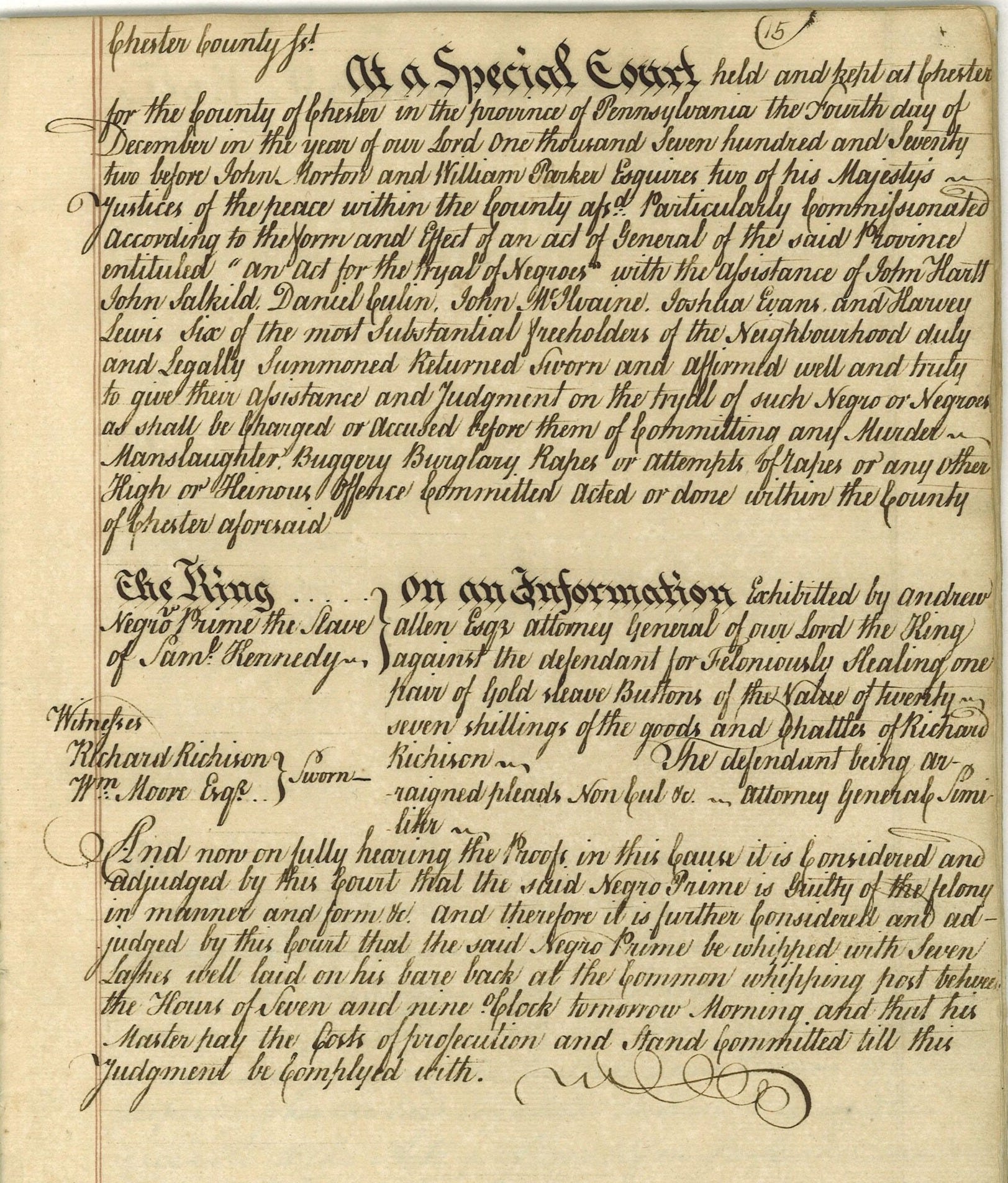
Unfortunately, we were unable to determine what happened to Prime after he was charged with theft. Due to the nature of slavery in Pennsylvania during this period, enslaved people were rarely documented. This was often intentional. Disturbingly, enslaved people were viewed more as “property” than as people within the culture of planter-class elites, and great effort was made to strip them of their agency and humanity. As a result, tracing what happened to Prime after 1772 has proven difficult, and we have even less context about his life than we do for Rina, Lucia, and Kitte.
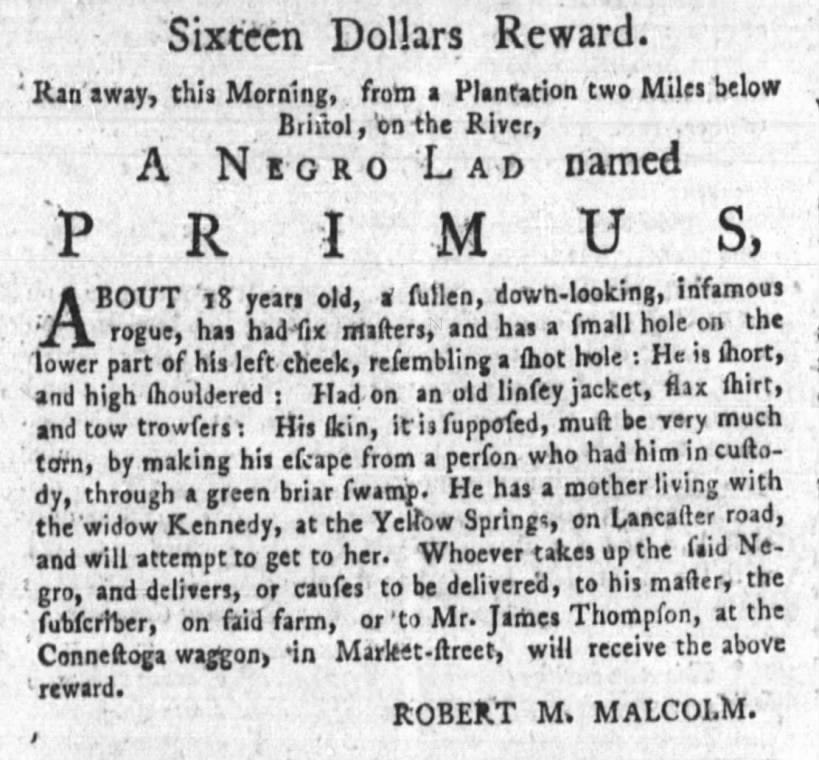
Then, we found a clipping from the Independent Gazetteer from October 12th, 1782 that references an enslaved young man named Primus and Sarah Kennedy of Yellow Springs3. Regardless of the closeness of the names ‘Primus’ and ‘Prime’ (though that certainly caught our eye) the mention of this young man’s mother living in the household of the widow Kennedy meant this clipping warranted further evaluation.
Primus
The advertisement that was taken out by Robert M. Malcom in this newspaper describes Primus fairly cruelly. He s described as “sullen” and “down-looking”, and is noted to be an “infamous rogue”. At this point, Primus is an eighteen-year-old young man who was so desperate to escape his enslavement that he had to wade through a green briar swamp, and so the slaveholder is sure to note that his skin will have been cut up by the thorns. He also notes that Primus has a ‘hole’ (presumably a scar) on his cheek, and records that it resembles a “shot hole”. In the lingo of the day- and as can probably be presumed- this refers to a bullet wound.
The horrors that Primus must’ve experienced in his short life, up until this point, is quite difficult for us to comprehend today. The cruelty he was treated with and the circumstances of his life are incredibly murky in documentation, but here, in this ad, we can see that those experiences left him with literal scars that would identify him for life.
To see if we could find out anything else about Primus, we double-checked the Chester County 1780 Slave Registry to see if his name is mentioned. However, we did not see any mention of him or Robert Malcolm in those records. Finding nothing, we checked to see what county Bristol- the township where the plantation Primus escaped from is located- is situated in. We discovered that Bristol is not in Chester County, instead it is in Bucks County. This means that if we are going to find records of Primus in the registry, we will have to use reference material from Bucks County instead.
Helpfully, the Bucks County Department of Parks and Recreation has compiled a few links on the topic in this website here4. Using these links, we were brought to a page that features several scanned images of the registry of enslaved people in Bucks county, which was completed in 1783, but (presumably) started in 17825. We scoured these scanned images for a mention of a Mr. Malcolm from Bristol, Robert Malcolm, James Thompson, a young enslaved man named Primus or Prime, or any combination of those options. Despite double and triple-checking, we were not able to find any record of him.
This is a setback, but it also demonstrates just how much documentation from the period is missing, despite the fact that we know Primus and Robert Malcolm definitely existed. This lack of documentation— even in cases where records should legally have existed— highlights how difficult it can be to reconstruct someone’s life using surviving historical sources.
There are a number of reasons why Primus may not have been recorded. In 1783, Robert Malcolm may not have been living in Bucks County or Bristol; the page containing the documentation may have been lost or destroyed over time; or perhaps Robert Malcolm deliberately failed to comply with the Act to Abolish Slavery and successfully avoided registering. However, while we can speculate, we cannot know why Primus was not recorded without further information.
However, what we do have, from this ad, is confirmation that Primus is very likely Rina’s son. Robert Malcolm advises that Primus is eager to return to his mother, who lives with Sarah Kennedy, and at the time the only person enslaved in the Kennedy household that this could be would be Rina.
Primus and Prime
One may note that the names “Primus” and “Prime” are extremely similar. As a caveat, when exploring old records, it is important to remember that spelling during the 18th century was far less standardized than it is today. Additionally, spelling mistakes were quite common, and when evaluating records, we must understand that names were often written phonetically. This means that the same person’s name can frequently appear in a variety of forms. Because of this, it would be understandable to hypothesize that Prime and Primus might be the same person.
However, that theory encounters a problem when we consider the ages of the individuals involved. From our experience tracing Lucia, Rina, and Kitte through the historical record, we know that the ages of enslaved people were often recorded imprecisely. Ages were generally rounded down, and there appears to have been very little care taken in documenting them accurately. That being said, for Primus to have been described as a “lad,” we can reasonably assume that he was just entering adulthood and would have been considered a young man. For this reason, we can use the age of 18, as mentioned in Robert Malcolm’s advertisement, as a reliable reference point. We can also confidently date this advertisement to 1782.
Our only record of Prime, who was enslaved by the Kennedy household, lists him as a in 1772, ten years earlier. If Primus was 18 years old in 1782, he almost certainly would not have been referred to as being fully grown in 1772. If he were younger, he most likely would have been indicated to as a boy in someway in the court document. Therefore, we can tentatively conclude that Prime and Primus were, indeed, two different people.
However, the similarity of their names is worth noting here. Although we cannot say for certain, it is fairly easy to imagine a scenario in which Primus may have been named after Prime, who could very well have been his father. This is highly speculative, but it is worth considering the ways in which the racial designations of these individuals were recorded.
Rina, Lucia, and Kitte are all designated as “mulatto,” a term that carried legal weight at the time and generally indicated that they were born to an enslaved woman and a white father. In all the documentation we are able to find for Prime and Primus, they are referred to as “negro”, hinting that they likely were not mixed-race.
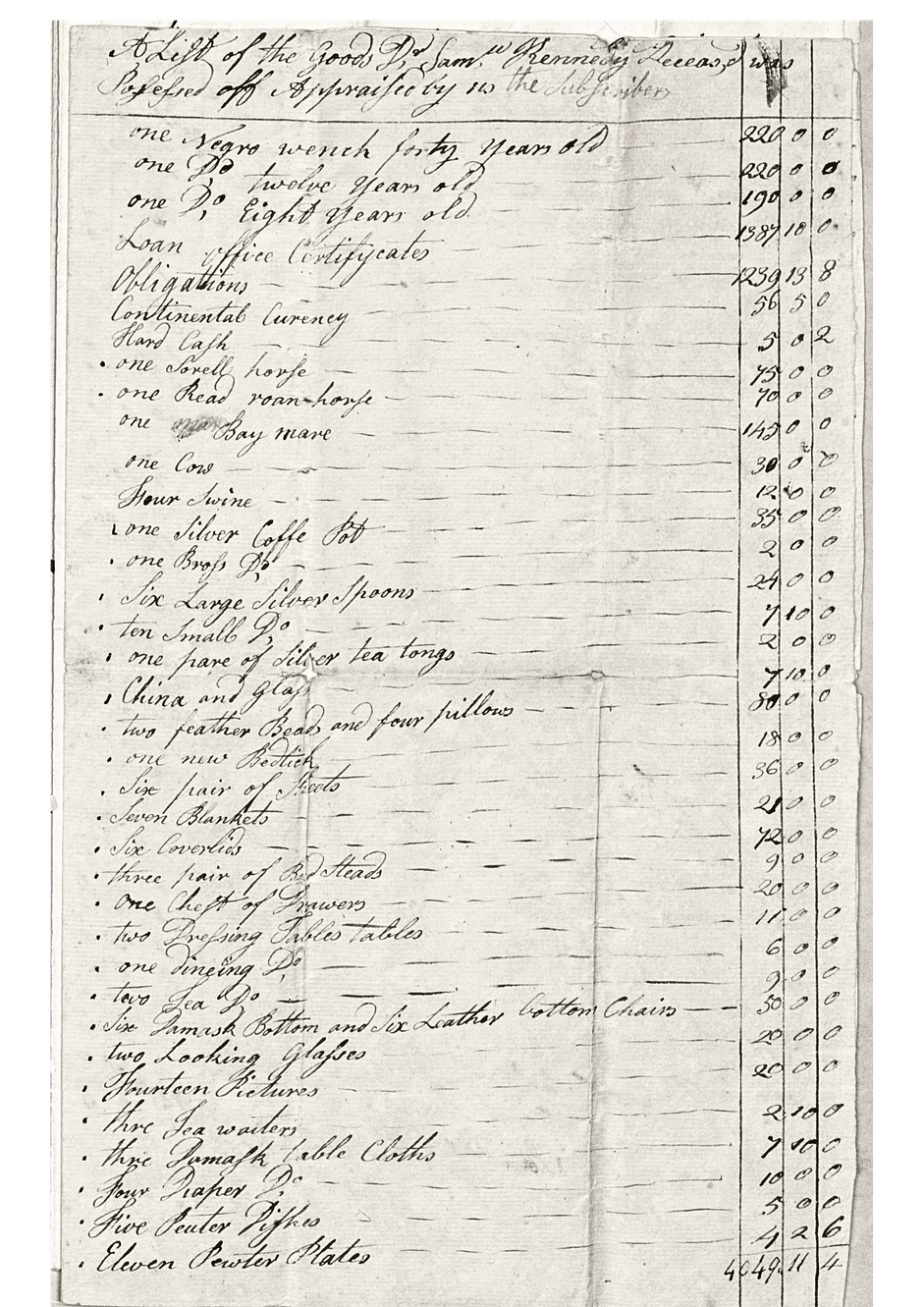
That said, this interpretation is somewhat uncertain, since the records we have for Prime and Primus do not come from the same registry in which such classifications would have been more strictly enforced. We also know that in more informal documentary contexts, the designation “mulatto” was sometimes omitted, as is the case in the index of Dr. Samuel Kennedy’s property, where all three are referred to as “negro.”
It is worth considering, however, that neither Prime nor Primus are described as “mulatto” in the records we currently have. Again, this is not conclusive, since they appear in documents that may not record racial classifications consistently, but it is quite possible that both would have been categorized simply as “negro” within the broader racial caste system of Pennsylvania at the time. This means that they would have had ancestry that is strictly of African decent.
This matters because, since Rina was almost certainly Primus’s mother— the person he appears to have longed to return to— then his father was likely an enslaved man as well. This possibility aligns with what little we can infer about Prime from what little we have.
What Does This Mean?
It can be difficult to parse out what these threads of documentation would have looked like for the people who lived through it. We do not know where Prime, Rina, Lucia, Kitte, or Primus came from, or the circumstances in which they were enslaved— all we can do is make educated guesses about the most likely circumstances in which they lived.
We are fairly confident that Rina, at the very least, was originally from the household of Job Ruston, Sarah Kennedy’s father. We have inferred that it is very likely that Lucia and Kitte may have been her daughters, and we now have some strong evidence that Rina had a son named Primus.
It is highly possible that Primus’s father was the man named Prime who, tragically, only appears in any form of documentation once- and that documentation is not a benign or neutral form of documentation. It is possible that Prime was purchased by the Kennedy household after Samuel Kennedy placed an ad in the Pennsylvania Gazette on February 27, 17726, (though this would make it fairly improbable that he would be Primus’s father) but we also know it is very possible that the Kennedy family owned more slaves than are documented by 1780.
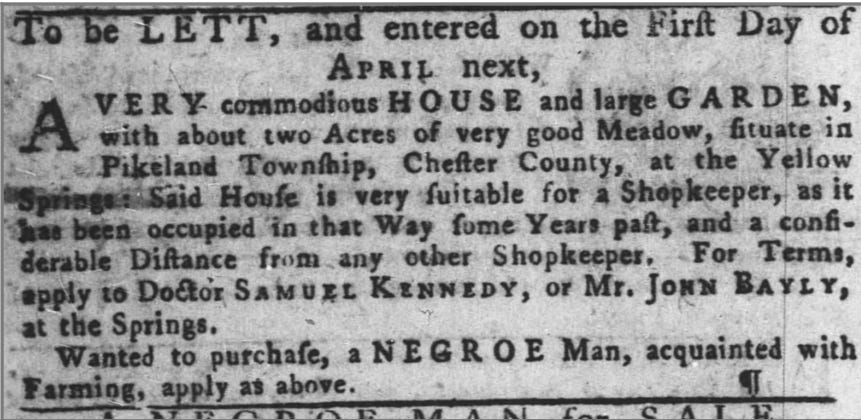
Taking all of this into consideration, we are left with a tragic portrait. It is very possible that these names are all that remain of a family who were sold off and separated from one another at the whims of people who considered them mere property. It is also possible that Prime and Primus are not two different people, and that Primus, as a young child, was punished severely for stealing a few buttons— though this is less likely, since legal documents like the Court Record would most often have indicated that he was a boy if that were the case.
To Us, Today
It is frustrating, today, to examine this story without any real sense of clarity to hold onto. But what we can know for certain, and what we must remember as we reflect on Prime, Primus, Lucia, Kitte, and Rina— is that these were real people with real bonds and real emotions who were forced to exist within a system that was designed to strip them of their humanity. When we look at Robert Malcolm’s advertisement for a reward if Primus is returned to him, we can see the callousness with which these people were treated.
But when we look closer, at who Robert Malcolm suspects Primus has escaped to reconnect with, we can see something profound. This young man struggled through a bog full of briars and risked life and limb to attempt to go see his mother again. While it is heart-wrenching and tragic that he had to do so, this action speaks to the love and care that they must have had for each other.
Despite the best efforts of the entire corrupt system around them, that sense of care and community could not be forced out of them.
We do not know what happened to Primus, but we can hold onto a little bit of hope for him. He does not show up in the index of enslaved people that was conducted the same year— and though perhaps it is naively optimistic, one can’t help but hope that he was truly able to escape.
⛓️💥🏃♂️➡️
See more online at: Historic Yellow Springs
⛓️💥🏃♂️➡️

Chester County Archives and Records Services. “1780 Slave Register.” Chester County, Pennsylvania. Accessed April 23, 2026. https://www.chesco.org/4572/1780-Slave-Register
“Trial of Prime, the Negro of Samuel Kennedy,” Court for the Trial of Negros, 10, Chester County Laserfiche Public Portal, accessed May 7, 2026. https://portal.laserfiche.com/Portal/DocView.aspx?id=771180&repo=r-24f48cc6
“Sixteen Dollars Reward for Negro Lad Primus, Issued by Robert M. Malcolm,” The Independent Gazetteer, October 12, 1782, accessed May 7, 2026, via Newspapers.com.
“The Enslaved People of Pennsylvania,” Bucks County, Pennsylvania, accessed May 7, 2026. https://www.buckscounty.gov/1556/The-Enslaved-People-of-Pennsylvania
Pennsylvania State Archives, “RG-47: Records of the County Governments (Microfilm Copies), Bucks County, Prothonotary, Register of Slaves, [ca. 1783–1830],” Pennsylvania Historical and Museum Commission, accessed May 7, 2026, via online portal
“Advertisement from Dr. Kennedy,” The Pennsylvania Gazette (Philadelphia), February 27, 1772, accessed May 7, 2026, via Newspapers.com.
 | A guest post by
|